FREE. FAIR. GLOBAL.
Security Council Hears Yemen Has Returned to War as Houthi Strikes Hit Saudi Airports
The UN Special Envoy warned that Yemen had returned to full-scale war as Council members condemned attacks on Saudi airports and urged protection for civilians and aid workers.
Katherine Knisely
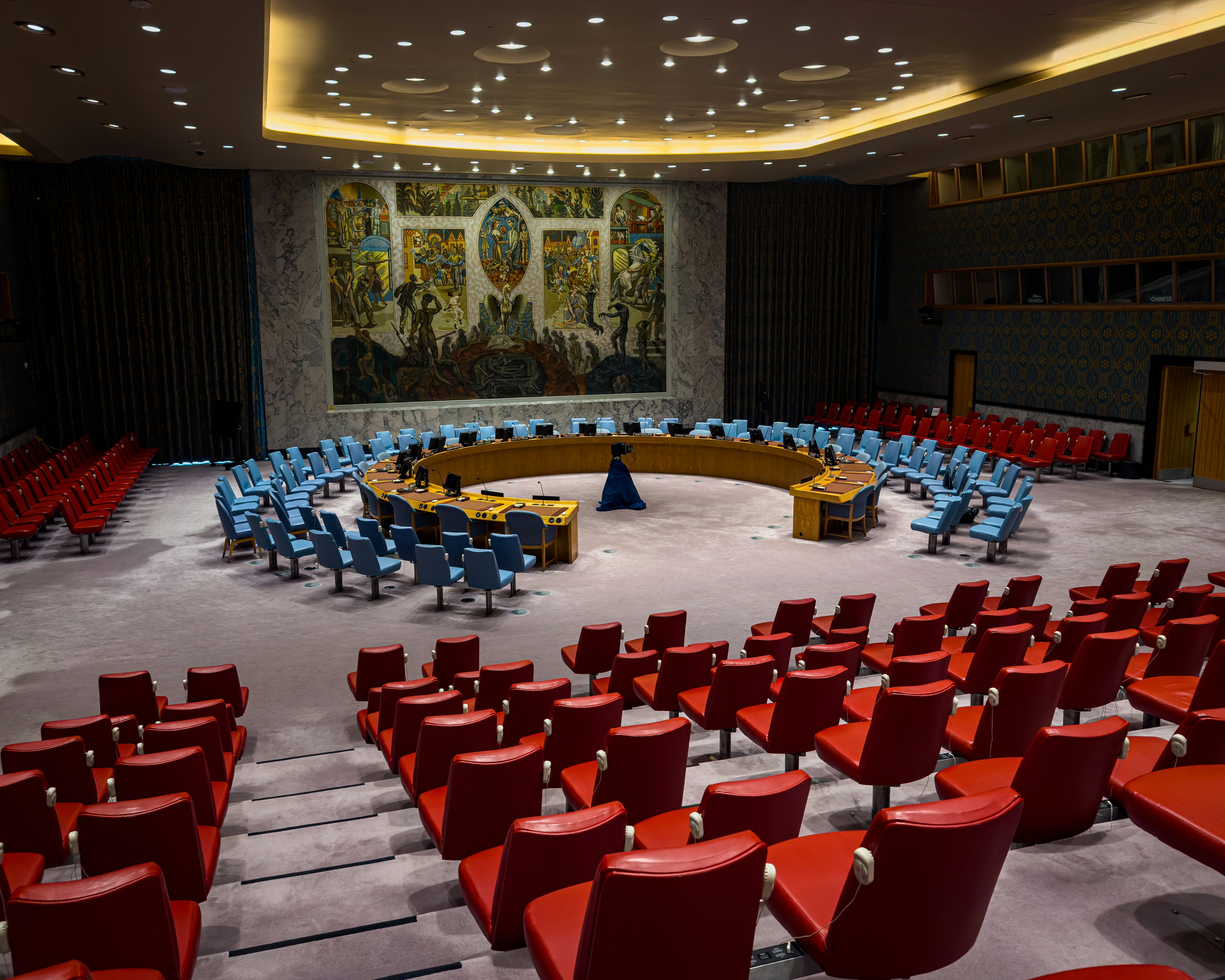

The UN Special Envoy warned that Yemen had returned to full-scale war as Council members condemned attacks on Saudi airports and urged protection for civilians and aid workers.
Yemen has slid back into full-scale war, the UN Special Envoy for Yemen told the Security Council on 9 October. Council members condemned Houthi targeting of Saudi airports, warning that the worsening humanitarian crisis disproportionately affects women and children.
Following the Council’s September briefings, Special Envoy Hans Grundberg reported that fighting had spread across multiple theatres, from the coast along the Bab al-Mandab Strait to Taiz, Ma’rib and Hajjah. He also condemned attacks against civilian and energy infrastructure in Saudi Arabia. Saudi Arabia’s General Authority of Civil Aviation reported that attacks on Abha International Airport and King Khalid International Airport in Riyadh on 6 and 7 October killed three people and injured 36 others.
Members expressed condolences over the airport strikes. Bahrain recalled the Council’s 18 September press statement condemning Houthi aggression and urged members to move beyond condemnations.
The United States, France, Denmark and Latvia underlined Iran’s role in supporting the Houthis. France said Iran was arming the group in violation of the embargo established by resolution 2216, and that the Houthis could not carry out their campaign without that support. The United States called on Iran to cease all support to the Houthis.
Latvia argued that the Houthis’ actions contradicted their claim to speak for Yemenis. It said pressure on UN staff to leave areas under Houthi control demonstrated disregard for the humanitarian needs and wellbeing of the people they claimed to represent.
Russia called on all parties to show maximum restraint and return to talks, and lamented the disruption of international shipping and trade. China urged the parties to use the UN Military Coordination Committee to avoid miscalculation. The A3, comprising the Democratic Republic of the Congo, Liberia and Somalia, also called for maximum restraint.
France stressed freedom of navigation, saying no party could claim the right to control the Bab al-Mandab Strait in violation of international law and resolution 2722.
The humanitarian picture was a major pillar of the briefings. According to the UN-published transcript of his remarks, Assistant Secretary-General for Humanitarian Affairs Mohamed Yahya reported that more than 200,000 people had been displaced since August, the highest level of new displacement since the 2022 truce, and nearly 4,000 had fled to Djibouti and Somalia. Even before the escalation, he said, 2.2 million children under five were acutely malnourished. Only three in five assessed health facilities were fully functioning, cholera and measles were spreading, and the humanitarian appeal was only 22% funded.
Aid work also faces serious obstacles. Grundberg said 72 UN personnel remained arbitrarily detained, alongside personnel from NGOs, civil society and diplomatic missions. In a statement issued on 5 October, the World Food Programme welcomed the recent release of one staff member and called for the release of all detained UN personnel and other humanitarian workers. Council members renewed those calls.
Members broadly agreed that there was no military solution. China urged a political settlement, while the United Kingdom, the A3 and Latvia also said force would not resolve the conflict. Speakers including Russia, China, France, the United Kingdom and Saudi Arabia backed Grundberg’s mediation.
Bahrain described the upcoming sanctions review as a chance to close the routes through which the Houthis obtain weapons. The Yemen sanctions regime was established under resolution 2140. Under resolution 2801, its time-limited asset-freeze and travel-ban measures run until 14 November 2026. The United States urged members to act on the Panel of Experts’ recommendations to cut off supplies of dual-use components and precursor chemicals.
This report draws on UN briefings, member-state statements and agency announcements. Some meeting details are attributed to the UN’s automated transcript, which is not an official meeting record.
Sources
- UN DPPA: Yemen has returned to full-scale war, Special Envoy warns
- GACA statement on attacks at Abha and King Khalid airports, 7 October 2026
- WFP statement on release of staff member in Yemen
- Latvia statement at the Security Council briefing on Yemen, 9 October 2026
- Security Council press statements in 2026
- UN Security Council Yemen sanctions resolutions
- UN-hosted automated transcript of meeting 10236 (automated; not an official UN record)
- UN Web TV recording landing page (recording not independently replayed)