FREE. FAIR. GLOBAL.
Women’s share of peace negotiators falls to 5% as UN warns of rising sexual violence
Women made up 5 percent of peace negotiators in 2025, UN officials told the Security Council, as verified cases of conflict-related sexual violence doubled and women’s organizations faced funding cuts.
Reporting by Katherine Knisely; edited by GLOBAL.
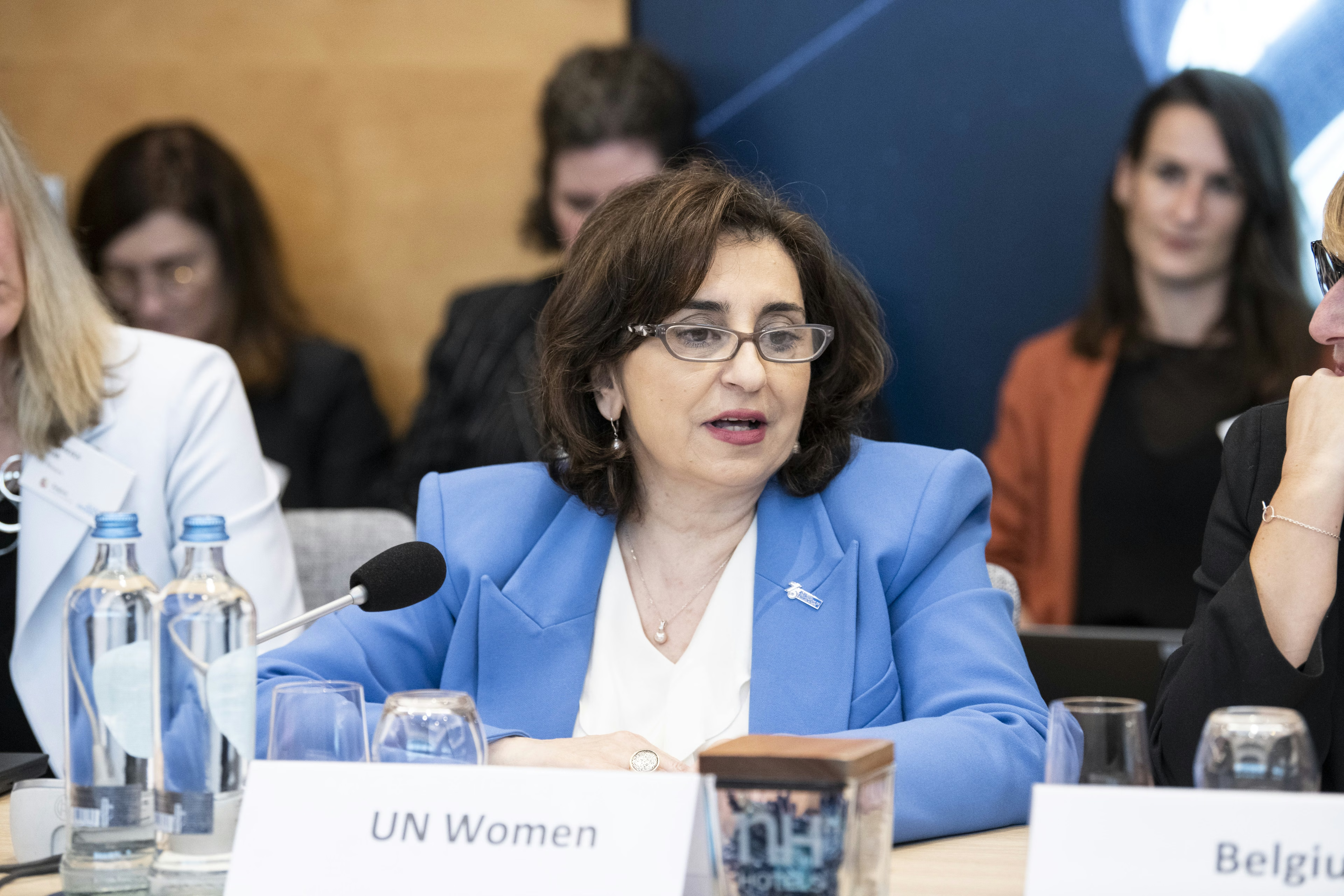
Reporting cutoff: October 27, 2026 Security Council session in New York
Edited by GLOBAL. from Katherine Knisely’s submitted article, with claims checked against the UN-hosted automated transcript and published speaker statements. The automated transcript is not an official UN record. Statistics and delegation positions are attributed to the speakers. This article covers the October 27 session only and does not report on the resumed October 28 proceedings.
Women were sidelined in the world’s peace talks last year, UN officials told the Security Council on Tuesday, October 27. Their share of negotiators declined as the number of UN-verified cases of conflict-related sexual violence doubled.
UN Women Executive Director Sima Bahous told the Council that across 57 peace processes reviewed for 2025, only 5 percent of negotiators were women, down from 7 percent the previous year—a decline of two percentage points. Nearly 80 percent of negotiations had no women at the table. Bahous attributed this exclusion to institutional barriers, unequal power dynamics, and entrenched gender norms. None of the 13 ceasefire agreements reviewed for 2025 referred substantively to women and girls, and none prohibited sexual violence, she said.
The UN verified more than 9,700 cases of conflict-related sexual violence last year, Secretary-General António Guterres said, while cautioning that the actual number was certain to be higher. Global military spending reached nearly $2.9 trillion while foreign aid fell, he said. A record 756 million women and girls live within 50 kilometers of armed conflict, Bahous told the Council.
Women’s groups on the front lines are also struggling. In a UN Women survey of women’s organizations in crisis-affected settings, 61 percent reported being financially worse off than a year earlier, and 45 percent had less than six months of funding remaining, Bahous said.
In the three processes the UN led or co-led, women’s participation reached 22 percent, still below the UN’s one-third goal, she added.
Afghan activist Tamana Zaryab Paryani, who filmed herself crying for help as Taliban forces surrounded her Kabul apartment in 2022, recounted her imprisonment and torture by the Taliban. She urged the Council to codify gender apartheid as a crime against humanity, support action at the International Court of Justice over alleged violations of the Convention on the Elimination of All Forms of Discrimination against Women, and stop normalizing ties with the Taliban. Toleration, she argued, allows such abuses to spread.
Bahous urged member states to ensure that peace processes they support meet the one-third minimum for women’s participation. She called for at least 15 percent of official development assistance to conflict-affected countries to advance gender equality, including at least 1 percent for women’s organizations. Guterres called for binding targets and quotas. Colombia and Greece backed the one-third target.
Greece, which presided, and Denmark called for sexual violence to be an explicit sanctions criterion, with Denmark specifying the Sudan sanctions regime. France urged permanent members to refrain from using their veto in situations of mass atrocities. Its representative also condemned Russia’s appearance in the annex to the Secretary-General’s report on conflict-related sexual violence over crimes in Ukraine.
Russia rejected the report’s framing of a backlash against gender equality as rooted in neoliberal ideology. Its delegate said Russian women contribute as professionals, not to fill quotas. China said it would contribute an additional $10 million to UN Women and make $100 million available through the Global Development and South-South Cooperation Fund over five years. The UK said it had announced more than $6 million the previous day to support survivors of sexual and gender-based violence in Sudan, alongside support for human rights defenders documenting atrocities.
Latvia and Luxembourg called for the next Secretary-General to be a woman. Liberia proposed three tests of implementation: whether women’s proposals shape settlements, whether those who brief the Council are protected from reprisals, and whether support for women’s groups endures after a UN mission leaves.
Several states reported national action plans, including Egypt’s first, but speakers highlighted the gap between commitments and delivery. Liechtenstein said the share of Council decisions containing women, peace and security language had fallen to its lowest point in 17 years.
At the close of Tuesday’s session, the Council announced that the debate would resume at 3 p.m. New York time on Wednesday, October 28. This report covers the October 27 session, not the resumed proceedings.