FREE. FAIR. GLOBAL.
Amid Conflict and a Fraying NPT, Middle East States Renew Push for WMD-Free Zone
Delegates met in the wake of an intensifying security landscape in the Middle East, and with the latest NPT review conference having ended without agreement. They agreed that a Middle East zone free of weapons of mass destruction (WMD) is more urgent than ever, but remain divided regarding why the process has stalled. Arab states and China blamed Israel’s absence from the NPT and Western double standards. France and the UK pointed to Iran’s nuclear program. Gulf states and Iran traded accusations over this year’s attacks, showing how far the region remains from consensus.
Katherine Knisely

November 16, 2026 · United Nations Headquarters
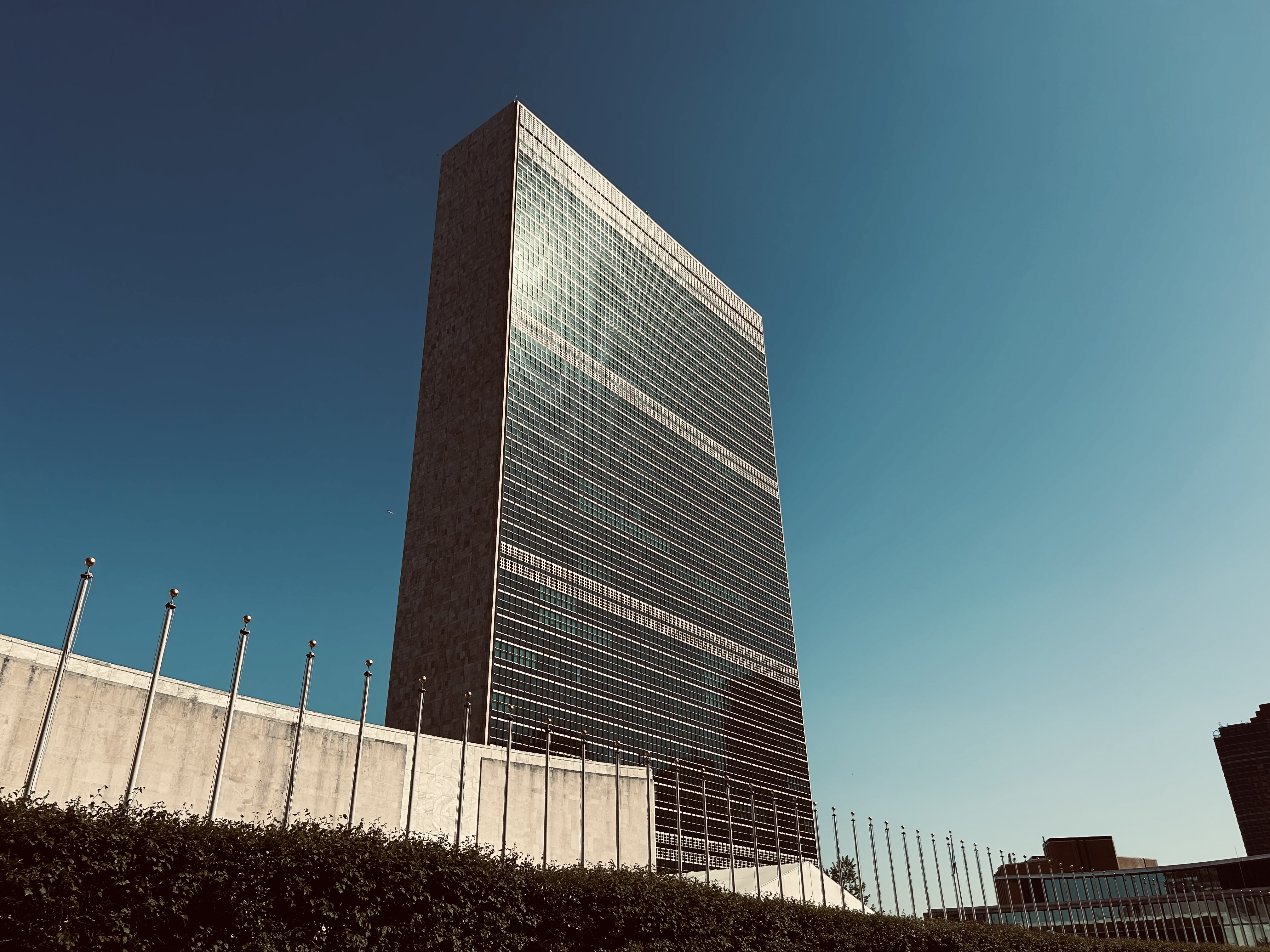
Analysis by Katherine Knisely. The author’s revised text and interpretation are retained. Statements and quotations were cross-checked against the UN’s automatically generated transcript; China’s quoted language also matches its published written statement. Automatic transcripts are not official UN records and may contain errors; this editorial check did not independently verify the audio. The photograph is archival institutional context, not an image of this meeting.
Delegates met in the wake of an intensifying security landscape in the Middle East, and with the latest NPT review conference having ended without agreement. They agreed that a Middle East zone free of weapons of mass destruction (WMD) is more urgent than ever, but remain divided regarding why the process has stalled. Arab states and China blamed Israel’s absence from the NPT and Western double standards. France and the UK pointed to Iran’s nuclear program. Gulf states and Iran traded accusations over this year’s attacks, showing how far the region remains from consensus.
Delegates met at UN Headquarters on November 16 for the second meeting of the seventh session of the Conference on the Establishment of a Middle East Zone Free of Nuclear Weapons and Other Weapons of Mass Destruction, chaired by Oman’s Ambassador Omar Alkathiri. Syria, Tunisia, China, and the League of Arab States framed the zone’s establishment as particularly imperative, given the conditions of deteriorating security in the region. They cited a year of escalation that has spread from Gaza, Lebanon, and Syria to the Gulf, along with strikes on nuclear facilities in Iran.
The meeting came as the non-proliferation regime weakens. The 11th Review Conference of the Treaty on the Non-Proliferation of Nuclear Weapons (NPT) ended without an outcome document. The League of Arab States called it the third such failure in a row and a blow to confidence in the treaty. China warned that “unilateralism and double standards are tearing apart” the regime amid rising talk of nuclear deterrence. Russia disagreed, arguing the review itself was an achievement and the 1995 Middle East resolution remains in force until fully implemented.
Israel’s absence dominated the debate. Syria, Tunisia, China, and the Arab League all urged Israel, the only state in the region outside the NPT, to join as a non-nuclear-weapon state and place its facilities under International Atomic Energy Agency (IAEA) safeguards. The League said holding other states to the treaty while overlooking Israel creates a “structural imbalance.” Russia said Israel was isolating itself, since the conference’s consensus rule fully protects its interests, and rejected US claims that the process targets Israel.
Western observers focused on Iran. France said the IAEA has no visibility over 440 kilograms of uranium enriched to 60 percent, and that Iran allows inspections only at its Bushehr plant. The UK voiced concern over Iran’s lack of cooperation with the agency and linked recent attacks on shipping and energy sites to the spread of missiles and drones. It urged states to adopt the Hague Code of Conduct, while France also pointed to the Missile Technology Control Regime. Russia, by contrast, condemned “unlawful and unprovoked US-Israeli aggression” against safeguarded Iranian sites. China defended Iran’s right to peaceful nuclear energy under IAEA monitoring.
There were signs of progress. France and the UK welcomed post-Assad Syria’s cooperation with the IAEA and the chemical weapons watchdog (OPCW), including the closure of the IAEA’s safeguards case against the former regime. The UAE urged lessons from the world’s five existing nuclear-weapon-free zones. The Biological Weapons Convention’s support unit warned that cheaper tools and technologies, such as AI, raise the risk of biological weapons reaching non-state groups.
Tensions flared at the close. Bahrain and Kuwait rejected Iran’s claim that Gulf states aided attacks on it. Kuwait asked whether its homes and desalination plants were US military bases. Iran called Security Council resolution 2817 hypocritical. Iraq and Kuwait clashed over drone attacks in April.
The session showed broad agreement on the goal but deep division over the obstacles. With Israel and the United States absent and the NPT under strain, simply keeping the conference alive may be its main achievement unless members move, as Russia urged, toward real treaty work.