FREE. FAIR. GLOBAL.
The House That Still Holds: The UN at 80 and the Fight to Matter in a World on Fire
The United Nations was built from the ash of world war. Eight decades later, it is being asked to prove that a room full of nations can still matter when the world feels louder, hotter, poorer, and more violent all at once.
GLOBAL. Editorial Desk
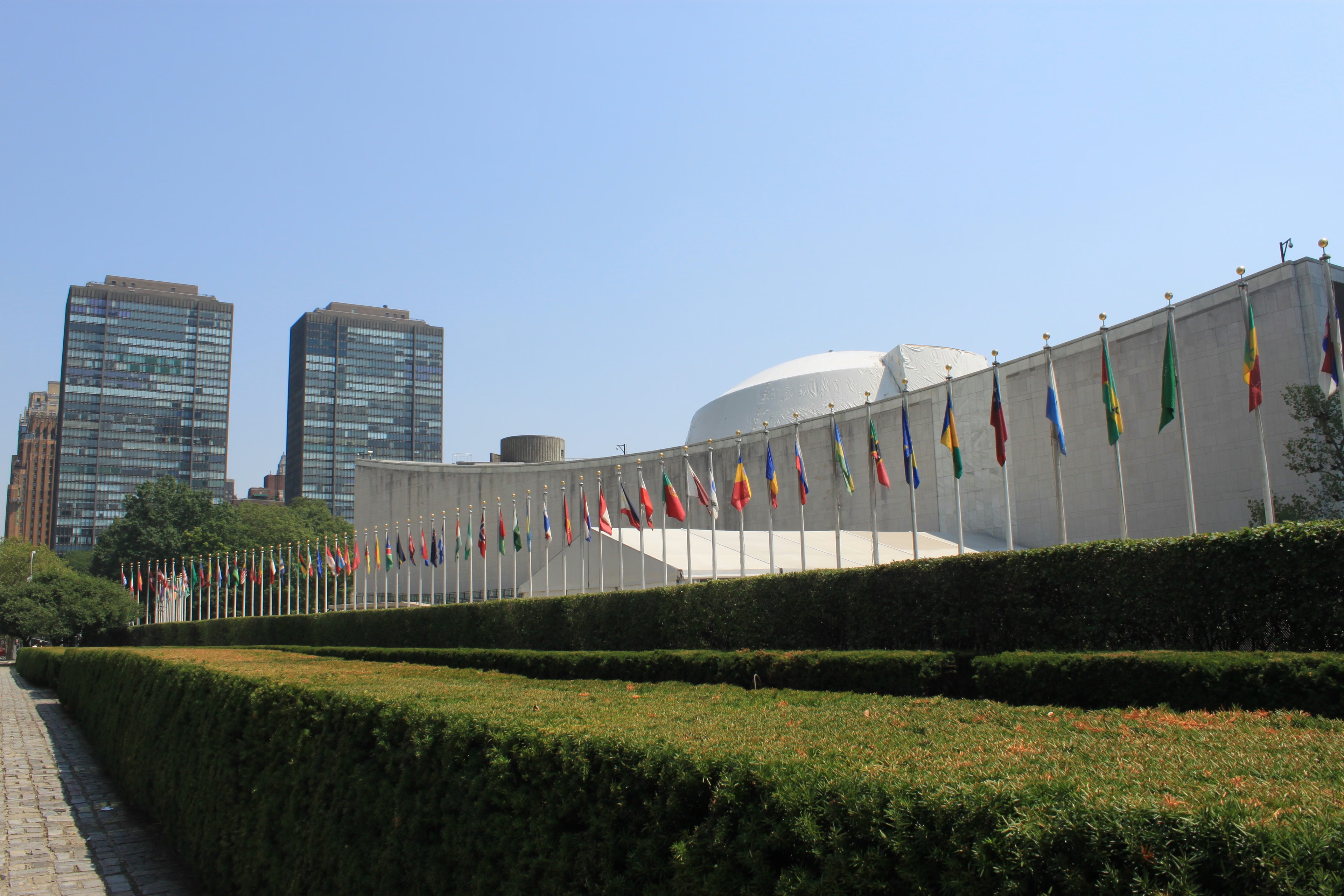

The first thing to remember about the United Nations is that it did not begin as a dream. It began as an emergency.
Before it was a blue flag, before it was a headquarters on the East River, before it became the place where world leaders perform outrage into microphones every September, the UN was a response to ruin. Cities had been flattened. Families had vanished into camps, bomb sites, hunger, and sea crossings. Europe and Asia carried the wreckage of total war. The Holocaust had exposed what a modern state could do when law became a costume. Nuclear weapons had made the next failure potentially final.
The United Nations was born because the world had learned, at almost unbearable cost, that nationalism without restraint could become machinery. It was not created because governments suddenly became noble. It was created because even self-interested governments could see the abyss.
Representatives of 50 countries met in San Francisco from April to June 1945 to draft the UN Charter. The document was signed on June 26, 1945, and the organization officially came into being on October 24, 1945, after ratification by China, France, the Soviet Union, the United Kingdom, the United States, and a majority of other signatories. What started with 51 Member States is now a near-universal body of 193. That growth alone tells a story: decolonization, liberation, statehood, fracture, survival. The UN is not only an institution. It is an archive of the world trying to name itself.
Its original promise was simple enough to be impossible: prevent another world war, defend human rights, uphold international law, advance social progress, and create a forum where nations could argue before they attacked. The ambition was historic. The structure was compromised from the start.
The UN was never a world government. It was built by states that wanted order but would not surrender sovereignty. Its strongest organ, the Security Council, gave permanent seats and veto power to the victors of the Second World War. That arrangement made the UN possible in 1945, but it also preserved the hierarchy of 1945 inside the machinery of the future. The institution was asked to be universal while carrying unequal power at its core.
This is the central contradiction of the UN, and it has never disappeared. The organization speaks in the language of humanity, but it operates through the consent, money, and politics of governments. It can condemn. It can coordinate. It can investigate. It can feed, vaccinate, observe, shelter, monitor, and sometimes deploy peacekeepers. But when the most powerful states decide to block action, the UN often becomes what its critics accuse it of being: a chamber of speeches beside a burning house.
Still, history is not honest if it only remembers the fires.
Across eight decades, the UN system helped build the modern vocabulary of rights, refugees, development, peacekeeping, public health, international law, food security, climate diplomacy, and humanitarian coordination. The Universal Declaration of Human Rights gave moral architecture to a world still recovering from state-sponsored horror. UN agencies became lifelines for children, displaced people, the hungry, the sick, the stateless, and the forgotten. Peacekeeping, improvised during the Cold War, gave the world a tool that did not exist in the Charter in quite the form it came to take: lightly armed or unarmed international personnel placed between conflict and catastrophe, not to win wars but to hold space for peace.
Since 1948, more than 70 UN peacekeeping operations have been deployed. The blue helmet became one of the few symbols on earth that could be recognized in a refugee camp, a demilitarized zone, a polling station, or a roadblock. Peacekeeping has failed, sometimes terribly. But it has also helped countries move from ceasefire to election, from armed factions to political process, from mass fear to fragile normal life. It is one of the UN's most human inventions: imperfect, dangerous, dependent on consent, and still necessary.
The UN's record is not a clean ledger. It is a contested map.
Rwanda remains a wound. Srebrenica remains a warning. Iraq in 2003 showed how a major power could go around the Security Council and damage the legitimacy of the very order it helped build. Syria showed how vetoes can turn diplomacy into ritual. Russia's full-scale invasion of Ukraine in 2022 forced the UN to confront the old nightmare: a permanent member of the Security Council violating the central rule against aggressive war. Gaza has exposed the gap between humanitarian language and civilian protection when military reality, political alliance, and veto power collide. Sudan has shown how a war can devour a country while attention moves elsewhere.
In 2026, the phrase "world on fire" is not just rhetoric. UN humanitarian pages describe hundreds of millions of people needing urgent assistance, with wars in Sudan, Gaza, Ukraine, and elsewhere driving displacement, hunger, and civilian harm. UNHCR reported 117.8 million forcibly displaced people at the end of 2025. Climate disasters are no longer background conditions. They are political events, economic shocks, migration pressures, health emergencies, and security risks. The old categories do not hold. War becomes hunger. Hunger becomes migration. Debt becomes instability. Heat becomes violence. Disinformation becomes governance.
This is why the UN's relevance crisis matters. People are not asking whether the UN is elegant. They are asking whether it works.
The answer is uncomfortable: sometimes, not enough. But the better question is what "works" means in a world where no single institution can force the powerful to be decent. If relevance means preventing every war, the UN has failed. If relevance means replacing national politics with global law, the UN was never built to do that. If relevance means keeping open the last universal room where enemies must still hear one another, where small states can speak beside empires, where evidence can be recorded, where humanitarian systems can coordinate at scale, where norms survive long enough to be used by the next generation, then the UN still matters profoundly.
The struggle for relevance has three wounds: power, money, and trust.
Power is the Security Council problem. The council reflects a world that no longer exists, yet controls decisions over war and peace in the world that does. Africa has no permanent seat. Latin America has no permanent seat. South Asia, despite its population and strategic weight, has no permanent seat. The veto can protect against reckless intervention, but it can also protect impunity. Reform is debated constantly because the case for reform is obvious. Reform also stalls constantly because the current arrangement benefits the states with the authority to block change.
Money is the delivery problem. The UN is asked to respond to emergencies created by war, climate, inequality, and state failure while depending on funding from governments that often underpay, delay, earmark, or politicize support. Humanitarian agencies face impossible choices: which hunger crisis receives a shipment, which camp loses services, which hospital runs without supplies, which education program disappears because food and shelter must come first. The UN's promise is universal. Its budgets are not.
Trust is the information problem. The UN was built for a world of states, diplomats, treaties, cables, and formal speeches. It now operates inside a digital storm where conspiracy travels faster than verification, where authoritarian governments mimic the language of sovereignty to hide abuses, where democratic publics are told that every institution is corrupt, and where even basic facts become partisan territory. A multilateral system cannot survive if citizens believe all cooperation is surrender.
And yet, this is exactly why the UN cannot be dismissed as obsolete. The forces making it look weak are the forces that make it necessary.
No country can solve climate alone. No border can stop a pandemic forever. No economy can isolate itself from debt, food shocks, shipping disruptions, cyberattacks, or energy volatility. No army can bomb its way into a stable planet. The UN is not relevant because it is powerful in the way a state is powerful. It is relevant because the biggest problems of this century are bigger than states.
The future of the UN will not be saved by nostalgia. It will be saved, if it is saved, by reform that makes the institution faster, fairer, more representative, and more honest about what it can and cannot do. The Pact for the Future, adopted in 2024, signaled that Member States know the system must adapt. The UN80 Initiative, launched around the organization's 80th anniversary, is trying to make the UN system more coherent, efficient, and fit for the century it actually serves. These are not glamorous words. They are operational words. And in a crisis, operations are morality made real.
The UN's critics are right about many things. It is too slow. It is too political. It is often trapped by the same governments it must confront. Its language can become fog. Its meetings can become theater. Its failures have graves attached to them.
But the alternative to the UN is not a cleaner world. The alternative is a world with fewer rooms, fewer rules, fewer witnesses, fewer channels, fewer norms, fewer places where the weak can address the strong, and fewer institutions designed around the radical idea that humanity is a political category.
At 80, the United Nations is not the answer to a world on fire. It is one of the last fire stations we have. Sometimes the trucks arrive late. Sometimes the water pressure fails. Sometimes the arsonists sit on the board. But the answer to that is not to burn down the station. It is to rebuild it while the smoke is still rising.
The UN began as an emergency. It remains one. Its relevance will not be proven by speeches about peace, but by whether it can help make peace more practical than war, cooperation more durable than cynicism, and survival more organized than despair.
The world is complicated. The need is not.
We still need a place where the world can face itself.