FREE. FAIR. GLOBAL.
To Keep the Fire from Becoming War: The UN's Original Purpose in the Age of Strongmen
The United Nations was created to prevent war by forcing power into a room with law. In an age of Trumpian politics and strongman performance, that original mission has become urgent again.
GLOBAL. Editorial Desk
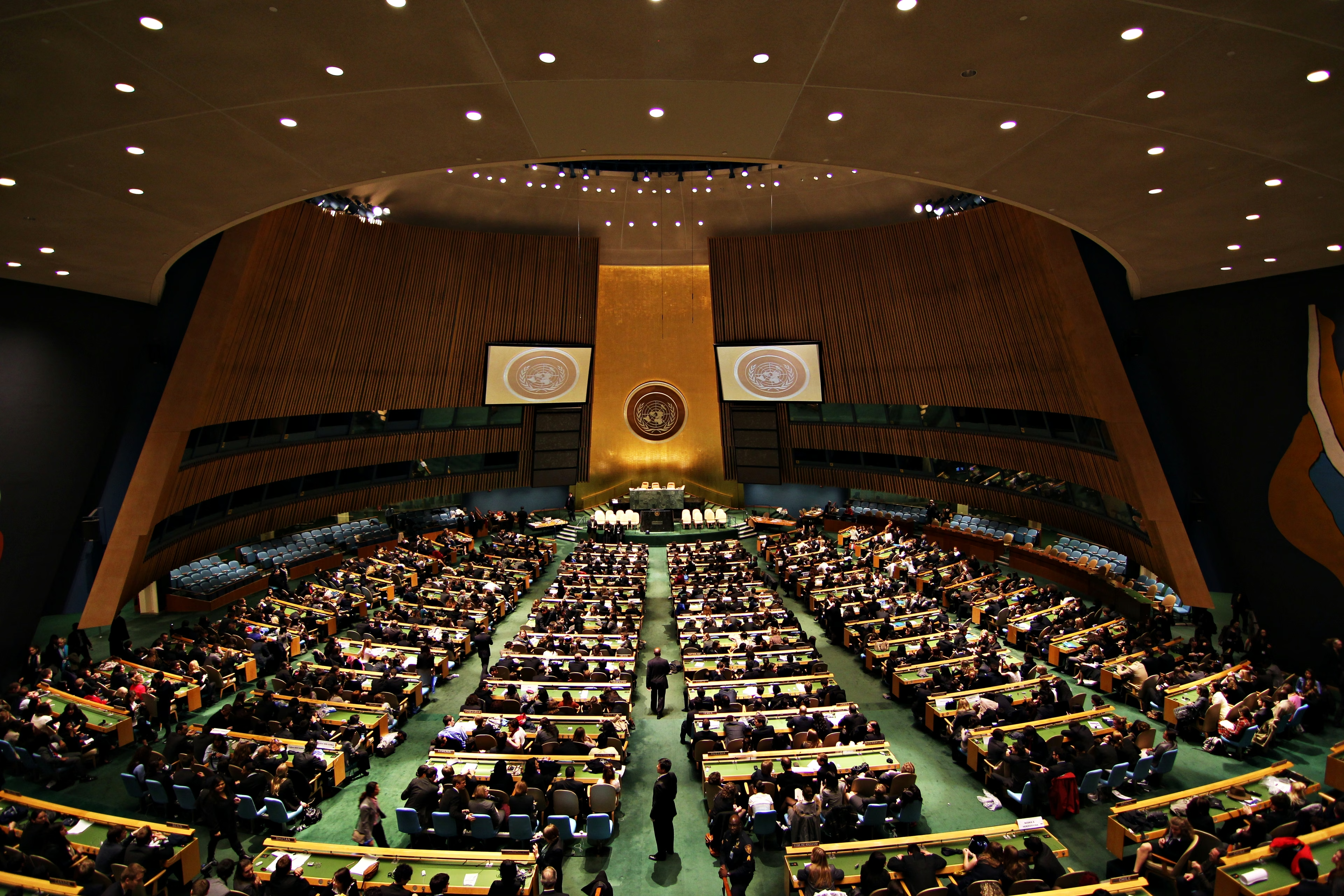

The United Nations was built around a fear that still understands us.
It was not the fear of disagreement. Nations have always disagreed. It was not even the fear of cruelty. Human history had supplied too much evidence for innocence by 1945. The fear was more specific: that modern states, armed with industrial capacity, mass politics, propaganda, and eventually nuclear weapons, could turn grievance into annihilation before diplomacy had time to breathe.
The UN's founding promise was to save future generations from war. That phrase can sound ceremonial now, worn down by repetition and schoolbook solemnity. But in 1945 it was not ceremonial. It was practical. The world had just watched leaders turn national humiliation, racial mythology, imperial appetite, and militarized masculinity into catastrophe. The lesson was not that evil had been defeated forever. The lesson was that evil had used institutions, laws, flags, speeches, factories, and ordinary obedience. If war was to be prevented, it would not be enough to hope for better leaders. The world needed structures that could restrain the worst ones.
That is why the UN matters in an age of strongmen.
"Trumpian" politics is not only about Donald Trump, though his return to power and his open suspicion of many international commitments have made the word globally legible. It describes a style of politics now visible across continents: the leader as brand, the nation as personal property, diplomacy as transaction, law as obstacle, allies as clients, journalists as enemies, foreigners as threats, and institutions as legitimate only when they submit. It is a politics of dominance over deliberation. It thrives on humiliation. It performs sovereignty as contempt.
The United Nations was not designed for saints. It was designed because the world knew it would have to survive men like that.
From the beginning, the UN tried to do something almost impossible: preserve national sovereignty while limiting what sovereign states could do to one another. The Charter did not abolish power. It tried to discipline power. It made the use of force a matter of international concern. It gave the Security Council primary responsibility for peace and security. It created a legal and diplomatic framework in which war would have to be justified, debated, condemned, authorized, or exposed. That may sound weak beside a missile. But before law can stop violence, it has to make violence answerable.
The League of Nations had failed partly because it lacked the participation, authority, and enforcement capacity to restrain aggression in the 1930s. The United Nations learned from that failure, but it also inherited the compromises required to bring major powers inside the tent. The permanent members of the Security Council received veto power because the architects of 1945 believed that a security organization without the strongest states would collapse, while a security organization that could bind them against their will might never be created at all.
The veto was the price of entry. It also became the source of paralysis.
That contradiction defines the history of the UN as a body to prevent war. It is strongest when major powers agree, and weakest when they are the problem. During the Cold War, the Security Council was often frozen by rivalry between the United States and the Soviet Union. Yet the organization did not become irrelevant. It adapted. Peacekeeping emerged as a practical invention: not exactly war-fighting, not exactly diplomacy, but an international presence designed to monitor ceasefires, separate forces, support political processes, protect civilians where mandates allowed, and create room for peace to become possible.
UN peacekeeping began in 1948 with military observers in the Middle East. It expanded through the Suez crisis, Congo, Cyprus, Lebanon, Cambodia, Namibia, El Salvador, Mozambique, East Timor, Liberia, Sierra Leone, and beyond. More than 70 operations have been deployed over the decades. Current peacekeeping is not romantic. It is dangerous, uneven, and politically constrained. More than 4,400 peacekeepers have died serving under the UN flag. Still, the principle remains extraordinary: countries send personnel into other people's wars, under an international mandate, not to conquer territory but to help keep a peace that would otherwise break.
This is one of the quiet achievements of the UN age. Not the end of war. Not the arrival of harmony. Something harder to celebrate and easier to overlook: the creation of habits, procedures, pressures, and presences that make some wars shorter, some ceasefires sturdier, some elections possible, some civilians safer, some armed groups monitored, some borders less combustible, and some leaders less able to claim that nobody is watching.
But the failures are enormous, and they must be named without euphemism.
The UN failed to prevent genocide in Rwanda. It failed to protect thousands at Srebrenica. It was divided and damaged by the Iraq War. It has struggled to stop mass atrocities in Syria. It has been unable to force an end to Russia's war against Ukraine because Russia itself holds a permanent Security Council seat. It has watched Gaza become a devastating test of civilian protection, humanitarian access, hostage diplomacy, international law, and great-power politics. It has sounded alarms on Sudan while the war has produced mass displacement and hunger. Again and again, the UN has shown that a system built to restrain war cannot fully function when powerful states or protected allies decide restraint is optional.
This is where strongman politics becomes especially dangerous.
The UN system depends on a basic idea: that even powerful countries benefit from rules they do not control completely. Strongman politics rejects that idea. It treats rules as traps set by others. It reframes compromise as weakness. It converts international institutions into stages for resentment. It tells publics that cooperation is humiliation and that withdrawal is strength. In January 2025, the Trump administration began the process of withdrawing the United States from the World Health Organization, and U.S. agencies announced completion of that withdrawal in January 2026. In January 2026, the White House also announced withdrawal from dozens of international organizations and UN entities it said did not serve U.S. interests. Those moves were not acts of war. But they were part of a larger anti-multilateral posture that matters for peace because the habits of cooperation are connected.
War prevention is not only ceasefire negotiation. It is public health cooperation before a pandemic destabilizes societies. It is climate cooperation before scarcity intensifies conflict. It is refugee protection before displacement becomes regional crisis. It is human rights monitoring before persecution becomes mass violence. It is arms control before fear becomes arms race. It is development before hopelessness becomes recruitment. It is the daily architecture of restraint.
When leaders mock that architecture, they may not destroy it immediately. They loosen the bolts.
The age of strongmen is also an age of performance. Leaders do not merely make decisions; they stage dominance for domestic audiences. International organizations become useful enemies because they are distant, procedural, and easy to caricature. A courtroom in The Hague, a committee in Geneva, a resolution in New York, a rapporteur's report, a humanitarian appeal, a climate pledge: all can be turned into symbols of foreign interference. The strongman does not need the public to understand the institution. He needs the public to resent it.
That resentment is powerful because the UN is genuinely frustrating. Its language can be bloodless. Its processes can be slow. Its agencies can be bureaucratic. Its councils can be hypocritical. Its most powerful members often violate the principles they publicly defend. No serious defense of the UN should pretend otherwise.
But hypocrisy is not an argument against law. It is an argument for applying law more consistently.
The UN's war-prevention mission should be judged against the real alternative, not the imagined one. The alternative is not a world where morally pure institutions act with speed and courage. The alternative is a world where there is no universal forum, no Charter standard, no Security Council record, no peacekeeping legitimacy, no humanitarian coordination at scale, no global legal vocabulary for aggression, no small-state platform, no Secretary-General able to speak across conflicts, no place where governments must at least explain themselves before history.
The UN cannot force peace on leaders who prefer conquest. It cannot make permanent members surrender veto power by moral persuasion. It cannot protect every civilian. It cannot prevent every invasion. It cannot turn nationalist spectacle into international responsibility by issuing statements.
But it can do something strongmen hate. It can remember.
It can record violations. It can preserve legal standards. It can convene coalitions. It can give smaller countries a microphone. It can move aid through systems no single state could build alone. It can monitor borders and elections. It can authorize peace operations. It can keep alive the principle that sovereignty is not a license for unlimited violence. It can insist that civilians are not scenery. It can make the powerful hear the names of the people they would rather reduce to numbers.
The UN's future as a war-prevention body requires reform that goes beyond slogans. The Security Council must become more representative. The veto must be constrained, especially in cases of mass atrocity. Peacekeeping mandates must be clearer and better resourced. Mediation capacity must be strengthened before conflicts metastasize. International law must be defended by democracies even when allies are accused. Humanitarian access must not depend on the convenience of belligerents. Digital disinformation, hate speech, and atrocity incitement must be treated as conflict risks, not merely communications problems.
Most of all, citizens have to understand that multilateralism is not a favor governments do for the UN. It is a survival tool governments build for themselves.
The world of 1945 knew what happened when aggressive leaders were appeased, when minorities were dehumanized, when propaganda captured public life, when treaties became scraps of paper, and when countries waited too long to believe what was happening in front of them. The world of 2026 does not have the excuse of innocence. We know the pattern. We have seen the rallies, the threats, the invasions, the expulsions, the camps, the bombed hospitals, the mass graves, the broken ceasefires, the men who mistake fear for greatness.
The United Nations was created for the moment before war becomes inevitable. That is the moment strongmen try to erase. They want politics to feel like destiny, conflict to feel natural, enemies to feel permanent, and restraint to feel pathetic.
The UN exists to say no: war is a choice, law is a memory, civilians matter, and power must answer to something beyond itself.
It does not always succeed. It may not succeed enough. But in an age of Trumpian characters, its original purpose is not old. It is returning.
The blue flag was never magic. It was a warning stitched into cloth: if the world does not build rooms for argument, it will build ruins for mourning.
Sources
- United Nations, "UN Charter
- United Nations Charter full text, Article 24 on Security Council responsibility
- United Nations, "History of the United Nations
- UN Peacekeeping, "Our History
- UN Peacekeeping, "What is peacekeeping?
- United Nations Office at Geneva, U.S. withdrawal from UN bodies context
- U.S. HHS, "United States Completes WHO Withdrawal
- UNHCR, "Figures at a Glance