FREE. FAIR. GLOBAL.
Myanmar’s war. The world’s supply lines.
How weapons, finance and fuel connect foreign suppliers to Myanmar’s military—and what years of UN investigations reveal about the human cost and the limits of international action.
GLOBAL. Politics & Affairs

Expanded reporting and primary sources checked 16 November 2026.
Historical supplier transfers and formal-banking procurement cover different periods and scopes; SIPRI transfer-volume measures answer a different question. These measures must not be combined. Supplier registration is not proof of government direction. Humanitarian estimates overlap and are not casualty counts. Legal status reflects the 16 November 2026 research checkpoint.
An arms story is also an accountability story.
Myanmar’s military does not sustain its war in isolation. Foreign weapons, manufacturing inputs, financial services and aviation fuel connect the violence inside the country to decisions made well beyond its borders.
In an October 2026 report, UN Special Rapporteur Kelley Anne Eckels-Currie described China as a “decisive enabler” of the conflict, pointing to the conflict economy and the supply of weapons and technologies that enable abuses by the military authorities and their proxies. That is an attributed UN assessment, not a judicial finding against China. The report also identifies the influence of neighbouring Thailand and India, and the military authorities’ ties with Russia and Belarus. 01
For the Rohingya, the question carries a particularly grave history. UN investigators have identified evidence of genocidal intent; the International Court of Justice is considering Myanmar’s responsibilities under the Genocide Convention. Meanwhile, investigators continue to document military attacks on civilians across the country. The legal categories differ. The institution’s continuing access to outside resources is a thread running through them. 06 08 09
The warnings began before the coup.
The persecution of the Rohingya did not begin with the military takeover in 2021. UN investigators placed the violence of 2016 and 2017 within a much longer system of discrimination and exclusion. Their 2018 findings covered Rakhine, Kachin and Shan States, while the genocide investigation centred on the Rohingya in northern Rakhine. The distinction matters: Myanmar's different conflicts have intersecting histories, but their victims and the legal questions they raise should not be collapsed into one undifferentiated story.
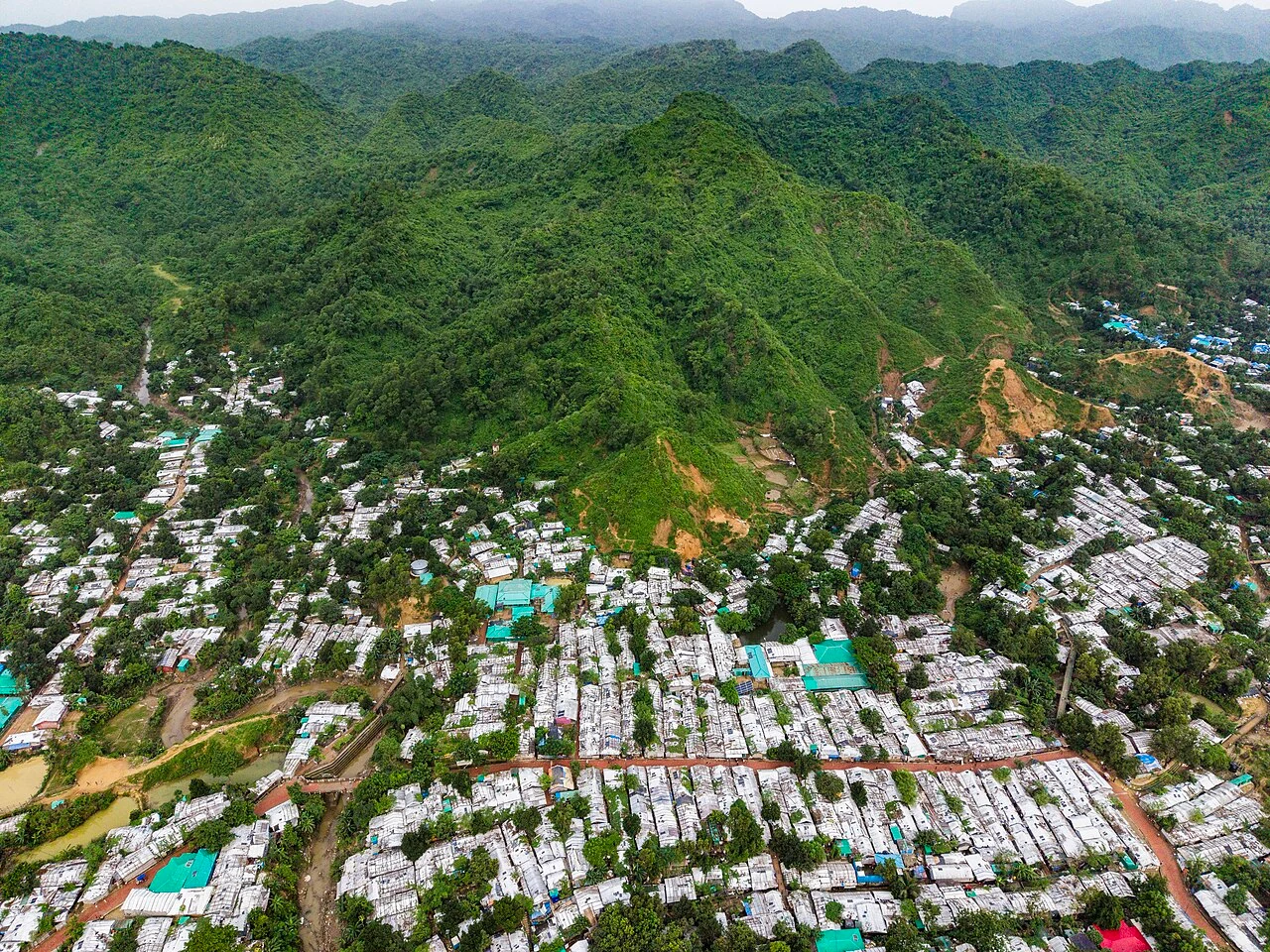
The flight across the Bangladesh border made the consequences visible far beyond Myanmar. A joint UN humanitarian statement in October 2017 recorded more than half a million Rohingya arrivals in less than five weeks following the escalation on 25 August. Those were people seeking protection, not a military-trade statistic. The camps were the immediate response to a mass emergency; years of displacement have since turned temporary shelter into a prolonged question of rights, safety and a viable future.
International concern about commercial support also predates 2021. In August 2019, the UN fact-finding mission examined the military's economic interests and urged targeted sanctions and an arms embargo. It identified foreign military suppliers and business relationships as part of the institution's wider support structure. Read beside the later procurement reports, that finding changes the central question: suppliers were entering a market about which serious warnings had already been publicly made. 19 18 20
Different countries. One military customer.
The historical UN investigation identified at least $1 billion in arms, dual-use goods, equipment and weapons-manufacturing inputs for February 2021–December 2022. Rounded reported values by supplier location were Russia $406 million, China including Hong Kong $267 million, Singapore $254 million, India $51 million and Thailand $28 million. 02
This is an incomplete minimum dataset published in May 2023, not current annual spending or proof of government direction. The map depicts schematic supplier relationships, not verified transport paths.
China and Russia matter. So do the intermediaries.
The 2023 UN investigation identified at least $1 billion in arms and related materials transferred after the February 2021 coup. Russia and China were the largest supplier locations in the documented dataset. State-owned suppliers were identified in Russia, China and India; Singapore and Thailand also featured as locations of private suppliers. The distinction matters: an exporter’s registration is not evidence that its host government directed the transaction. 02
The figures are a historical baseline, not a 2026 balance sheet. They establish the scale of a documented network while leaving gaps, including underreported flows. Currie’s October assessment brings the focus back to the present: the conflict’s outside enablers remain a political question even where fresh, comparable trade totals are unavailable. 01
The factory belongs in the supply-chain picture
An arms embargo focused only on finished weapons would miss part of the problem. The military’s domestic manufacturing system depends on imported machinery, components and materials as well as complete weapons from abroad. A January 2024 advisory issued by six US government bodies warned that goods ostensibly intended for civilian operators could be diverted to military uses, and identified aviation services, components and fuel as sectors requiring particular scrutiny. The analytical point is to examine the end-user and the surrounding business relationship, rather than assuming that a familiar commercial description makes a shipment harmless. Equally, a broadly useful product is not automatically evidence of an arms transaction: documents, ownership, recipient and intended use must support the conclusion. 25
Three measures that should never be added together
An arms-transfer statistic is meaningful only with its definition attached. The 2023 UN snapshot describes reported monetary values for a particular historical supplier network. The 2024 study examines a narrower set of military purchases using formal international banking channels. SIPRI’s Arms Transfers Database answers a different question again: it measures deliveries of major conventional weapons using a trend-indicator value designed to represent military resources, not their sale price. A SIPRI value must not be labelled US dollars, combined with procurement payments, or treated as a complete inventory of ammunition, industrial inputs and fuel. Different sources can illuminate the same military relationship while measuring different objects. The interactive views here retain their own periods, units and evidence limits so that switching a chart does not erase those differences. 39 02 03
Pressure can work. Networks can move.
Formal-system military procurement report estimates fell from $377 million for April 2022–March 2023 to $253 million for April 2023–March 2024. These are narrower banking-system figures, not the total global arms trade. 03
Restricting a supplier is one intervention. Closing the payment channel is another. The UN’s banking investigation shows why both matter.
Military procurement recorded through the formal international banking system. Some final-quarter purchases were approved or authorised, rather than independently confirmed as completed. 03
The 2024 UN report recorded a steep fall in Singapore-linked procurement and a shift towards Thailand-registered suppliers. It found no evidence that either government was involved in, or aware of, the transfers it examined. 03
Singapore publicly reiterated its restrictions and financial due-diligence measures. A 2025 UN update recorded further banking action in Thailand. But the rapporteur’s March 2026 report said progress had stalled in 2025. An apparent fall through formal channels cannot establish that procurement stopped. 04 12 13
Money is part of the military infrastructure
A weapons purchase does not end when a seller accepts an order. It also depends on the ability to pay across borders. In June 2023, the US Treasury designated Myanma Foreign Trade Bank and Myanma Investment and Commercial Bank, describing their role in foreign-currency exchange and the military’s access to overseas markets. The distinction between a seller and a payment intermediary matters. One supplies a product; the other can make the transaction financially possible. Studying both can reveal why a restriction on a company has limited effect when the wider commercial relationship remains available. The designation was a US sanctions action against named institutions, not a judicial conviction or an automatic worldwide prohibition on every transaction involving Myanmar. 27 03
Sanctions need maintenance, not just announcements
The enforcement record is a sequence, not a single turning point. In October 2024, coordinated UK, EU and Canadian announcements targeted military access to equipment, funding and aviation fuel. But the March 2026 rapporteur’s report concluded that progress had stalled during 2025 as procurement networks adapted faster than governments updated and enforced restrictions. An announcement can establish that a restriction exists in a particular jurisdiction. Its practical effect requires further evidence: what trade was disrupted, whether buyers changed intermediaries, and whether the restriction continued to apply to the people and institutions actually handling the business. The historical fall in formal-bank procurement is meaningful evidence of disruption. It is not proof that the military lost access to all external supply. 38 04
An aircraft also needs fuel.
Amnesty International verified at least nine aviation-fuel shipments carried by four vessels from mid-2024 to the end of 2025. Its January 2026 investigation described obscured shipping activity and suspected links to Iran, while making clear it could not confirm the suppliers or the fuel’s origin. 05
Fuel, weapons and finance are related but distinct evidence trails. A ship’s flag does not prove cargo origin. A national import is not automatically a military delivery. Those limits matter when tracing responsibility.
The end of the chain is a place people live.
The Independent Investigative Mechanism for Myanmar’s August 2026 report identified a pattern of deliberate military aerial attacks on civilians. Its reporting period ran from July 2025 to June 2026. Investigators examined attacks on homes, schools, medical facilities, religious buildings and displacement camps, alongside detention, torture and sexual violence. These are investigative findings, not criminal convictions. 06
The Rohingya face a distinct and continuing crisis. OHCHR’s August 2026 report described worsening conditions at the hands of both the military and the Arakan Army. Acknowledging abuses by other armed actors does not remove the need to scrutinise the military’s external procurement network. It keeps the account centred on the people whose protection is at stake. 07
There is no basis here to claim that every listed shipment has been traced to a particular atrocity, or that every supplier has been found legally complicit in genocide. There is a strong basis for asking why resources continue to reach a military after years of documented warnings—and whether the authorities and businesses controlling those resources have acted on the risks.
The damage extends beyond the moment of an attack.
UNICEF’s January–June 2026 report describes damaged schools, shortages of teachers and learning materials, and repeatedly interrupted education. It estimates that 3.4 million children needed educational support. Displaced families also faced difficulty reaching health care, safe water and sanitation. These consequences cannot be captured by a single death toll. 29
Food insecurity has several overlapping drivers. WFP's 2026 emergency overview puts acute hunger at 12.4 million people and identifies conflict alongside economic decline, pre-existing poverty, climate shocks, the March 2025 earthquake and cuts to humanitarian assistance. It would be misleading to attribute every person's hunger to a particular foreign shipment. It would be equally incomplete to describe weapons imports without considering the conditions in which the military continues to use force and the resources civilians need to survive. 30
The measures below describe different needs and observation periods. A person can face displacement, hunger and interrupted education at the same time. Keeping the categories separate gives a more useful account of civilian life than adding them into a larger headline.
A commercial record is a lead. A case needs a chain of evidence.
A payment, a company registration and a weapons photograph answer different questions. Together they may illuminate a network; separately they cannot establish every link between a supplier and a crime. The IIMM's published methods explain why investigators combine witness accounts, documents, geospatial material, financial information and open-source records, checking one category against another rather than relying on a single compelling image or invoice.
That approach also separates an enabling relationship from a completed legal finding. An investigation must establish what happened, identify the people responsible and examine the applicable legal requirements. A supplier's presence in a historical dataset is not, on its own, a conviction. The commercial evidence is important precisely because it can be investigated further: who controlled an entity, what it supplied, what a decision-maker knew and how the relevant acts connect to the crimes under examination. 36
Three questions. Three different tests.
The arms network, the genocide case and individual criminal responsibility are connected. They are not the same proceeding.
The ICJ will address Myanmar’s obligations under the Genocide Convention in relation to the Rohingya. Its 2020 provisional measures were not a final merits judgment. The decision is scheduled for 19 November 2026. 09
The ICC prosecutor sought an arrest warrant for Min Aung Hlaing in November 2024 for alleged deportation and persecution of Rohingya. That was an application, not confirmation of a public warrant. Subsequent confidentiality rules limit what can be inferred. 10
IIMM says it has collected bank-transaction and weapons-chain evidence that may help identify people who financed or facilitated crimes. This is an investigative avenue, not a finding of guilt against every entity in a supply chain. 11
The law also asks questions before a weapon is used.
Criminal accountability after an atrocity and an export decision before a transfer are different tests. For states bound by the Arms Trade Treaty, Article 6 prohibits covered transfers in specified circumstances, including knowledge at authorisation that the items would be used to commit genocide or other listed international crimes. Article 7 separately requires an export assessment of risks to peace, human rights and humanitarian law. If an overriding risk remains after available mitigation is considered, the exporting state must not authorise the export.
The treaty is not universal. UN depositary records list China as a state party; its accession took effect on 4 October 2020. Russia, India and Myanmar are not listed as parties, while Singapore and Thailand have signed but not ratified. Those differences do not resolve every other international or domestic obligation. They do mean that a serious assessment must identify the country, the covered items and the legal rule that applies, rather than treating all suppliers as though they operated under an identical export-control system. 26 34 37
A court order cannot perform every other institution's job.
The International Court of Justice addresses a dispute between states under the Genocide Convention. The International Criminal Court investigates and tries individual criminal responsibility within its jurisdiction. The IIMM preserves and analyses evidence for competent authorities; it cannot itself arrest a suspect, bring a prosecution or hold a trial. These institutions can support one another, but a report from one is not a verdict by another.
Prevention requires decisions beyond the courtroom. In June 2021, the General Assembly called on member states to prevent arms flowing into Myanmar. That political call was not an automatic, mandatory Security Council arms embargo. Whether a particular shipment or payment is prohibited still requires attention to the applicable measures, jurisdiction and date. A sanction, a licensing refusal and a criminal charge can affect the same network while resting on different powers and serving different purposes.
The practical test is therefore more demanding than asking whether another declaration has been issued. Are export applications refused where the rules require it? Are relevant financial records examined? Does credible evidence reach authorities able to act, with witnesses protected? Those are questions about implementation. A judgment can establish responsibility and clarify obligations; it does not replace the continuing work of regulators, investigators and national enforcement authorities. 28 09 10 23 26
What changes after the warning?
Weapons arrive through decisions: to approve an export, accept a payment, finance a counterparty or deliver a cargo. The evidence does not make every decision identical. It makes the network visible enough to ask who has the power to interrupt it.
This week’s court decision will be consequential for the Rohingya case. It will not, by itself, close a supplier, enforce an export restriction or stop a payment. Those choices remain with governments, banks and businesses—and their consequences remain with civilians.
China, including Hong Kong — Aircraft, industrial inputs and sustained influence
China’s role extends beyond the sale of complete weapons. The 2023 UN investigation identified aviation equipment, maintenance, communications and industrial materials, and named China National Aero-Technology Import & Export Corporation, or CATIC, among the suppliers. Read together, those categories describe a relationship that can help maintain military capacity as well as expand it. A fighter aircraft and the support needed to keep an existing fleet operating belong to different parts of the same story.
The October 2026 rapporteur’s assessment adds a political dimension: Currie identifies China’s influence through both weapons and technology and the wider conflict economy. That assessment is not a newly audited dollar total. The historical supplier figure includes Hong Kong and does not show that every item was manufactured there or in mainland China. Nor does the appearance of a company in a supply dataset establish that a particular shipment was used in a particular crime.
Historical transfers: February 2021–December 2022; current assessment: October 2026. 02 01
Russia — The aircraft relationship includes sustainment
Russia was the largest supplier location in the UN’s historical snapshot. The report identified Rosoboronexport, the Russian state-controlled arms intermediary, as a central supplier, alongside firms providing aviation equipment and support. The importance of such a relationship is not captured by counting newly delivered aircraft alone. Repairs, replacement parts and support can sustain equipment purchased years earlier.
This is why a transfer investigation and an air-war investigation answer different questions. The first can establish the supplier, goods and recipient within a documented period. The second must establish what happened during an attack and who was responsible. The UN’s evidence connects Russian-origin aircraft types to the military’s operations, but the nationality of a platform is not, by itself, proof about every company or individual involved in supplying or servicing it.
Historical transfers: February 2021–December 2022. 02 14
India — A smaller supplier with a consequential border relationship
India’s documented transfers were smaller than those attributed to Russia or China, but included state-owned suppliers. The UN report names Bharat Electronics in connection with coastal surveillance and a weapons station, and Yantra India in connection with artillery components. In correspondence recorded by the rapporteur, India cited earlier commitments to Myanmar’s civilian government and its own border-security concerns. These are India’s explanations to the UN investigator, not a response obtained by GLOBAL.
The relationship remains broader than arms sales. An official Indian statement about bilateral talks in July 2026 describes border security, transnational crime and arms smuggling among the issues discussed. That record helps explain why security engagement persists. It does not establish a new weapons delivery or resolve the separate question of whether a specific export, recipient or end-use was adequately scrutinised.
Historical transfers: February 2021–December 2022; official engagement: July 2026. 02 15
Singapore — A business jurisdiction where enforcement changed the pattern
Singapore’s place in the network is principally a story about companies and financial services operating within its jurisdiction. It must not be confused with a finding that the Singapore government supplied weapons. The government’s February 2025 parliamentary reply reiterated that the UN rapporteur had found no indication of official approval or involvement in the shipments identified.
The enforcement response nevertheless matters. The UN documented a sharp reduction in Singapore-linked procurement after authorities investigated the earlier findings. The lesson is more demanding than simply labelling a country a supplier: a financial and commercial centre can identify risk, investigate the people and businesses behind transactions, and change the conditions in which they operate. That does not make all trade with Myanmar suspect. Civilian commerce and humanitarian activity need to be distinguished from support to military procurement.
Supplier evidence: 2021–2024; government reply: February 2025. 16 12 03
Thailand — The shift in procurement is followed by a contested regulatory record
The banking study recorded a rise in procurement from Thailand-registered sellers as Singapore-linked trade declined. The subsequent regulatory response belongs in the same account. In December 2024, Thailand’s central bank and Anti-Money Laundering Office said their investigation had found transactions involving people named in the UN report, but no evidence connecting the reviewed transactions to arms procurement. They also called for stronger checks on beneficial ownership and high-risk business.
The rapporteur disputed the adequacy of that conclusion and sought clarification about the investigation’s methods. His 2025 report also recorded Bangkok Bank’s decision to end its correspondent relationship and SWIFT arrangement with Myanmar Economic Bank because of procurement-related risk. The regulator’s finding, the UN investigator’s disagreement and the bank’s withdrawal are separate facts. None should be silently substituted for another, or treated as a complete account of Thai banking conduct today.
Banking study: April 2022–March 2024; regulatory response: December 2024; bank action: early2025. 03 17 13
The sequence of warnings and decisions.
25 August 2017 — Mass flight from Rakhine. Violence in Rakhine triggered a rapid exodus to Bangladesh. A joint UN statement issued in October recorded more than half a million arrivals in less than five weeks. The displacement is central to the later international cases and to the continuing refugee response. It also predates the 2021 coup: the Rohingya crisis has its own history of persecution, and should not be treated simply as a consequence of the more recent nationwide conflict. 18 19
5 August 2019 — The business ties come under scrutiny. The UN fact-finding mission published findings on the military's economic interests and called for sanctions and an arms embargo. Its inquiry connected military power with commercial interests, foreign suppliers and business relationships. This was an investigative recommendation, not a criminal conviction against each named company. The report is an important marker in the sequence of public warnings: international scrutiny of the military's support networks was already established before the post-coup procurement datasets began. 20
23 January 2020 — The World Court orders protective measures. Following The Gambia's November 2019 application, the ICJ directed Myanmar to prevent acts prohibited by the Genocide Convention and preserve relevant evidence. Provisional measures protect rights while a case is examined; they are not the final determination of the merits. The court later rejected Myanmar's jurisdictional objections in July 2022. The sequence matters because a protective order, a jurisdiction ruling and the eventual judgment answer different legal questions at different stages. 21 09
1 February 2021 — Military takeover changes the national crisis. The military declared a state of emergency and removed the elected civilian leadership. The takeover intensified the country's political crisis and became the starting point for the UN rapporteur's later post-coup arms-trade investigation. It did not mark the beginning of all armed conflict or atrocity allegations in Myanmar. A clear chronology keeps the Rohingya's earlier persecution, long-running conflicts in ethnic areas and the subsequent nationwide escalation connected without presenting them as the same event. 22 23
18 June 2021 — The General Assembly calls for an end to arms flows. Resolution 75/287 called on member states to prevent arms flowing into Myanmar, alongside demands concerning violence, detainees and humanitarian access. Its adoption created a clear political benchmark against which later transfers could be scrutinised. It did not, by itself, impose a mandatory Security Council arms embargo or turn every transaction anywhere into the same legal offence. The distinction between political commitments, treaty duties and domestic restrictions remains essential when assessing the response of individual governments. 23
17 May 2023 — A documented billion-dollar network. The Special Rapporteur's Billion Dollar Death Trade report assembled a minimum historical dataset covering February 2021 to December 2022. It examined arms and related materials, including dual-use goods and manufacturing inputs, by supplier location. The investigation supplies the baseline used in this feature's first trade graphic. Its publication date and measurement period are different: the values should not be read as current annual military spending, or combined with the later formal-banking study. 02
26 June 2024 — The banking study shows disruption and movement. Banking on the Death Trade examined military procurement through the formal international banking system across two financial years ending in March 2023 and March 2024. It recorded a decline in the overall documented value and a marked change in supplier-registration jurisdictions. Its narrower coverage is important: a reduction through observed banking channels does not establish that every route closed or that the entire arms trade fell by the same amount. Subsequent enforcement actions require their own dated assessment. 03
27 November 2024 — The ICC prosecutor seeks an arrest warrant. The prosecutor announced an application for an arrest warrant for Min Aung Hlaing concerning alleged crimes against humanity of deportation and persecution of Rohingya. The announcement was a prosecutorial request, not proof of a publicly issued warrant. A November 2025 court rule generally made applications and related decisions confidential unless judges decide otherwise. The public record therefore cannot support an assumption that a warrant was issued publicly, or that the application necessarily remains pending. 10
25 January 2026 — The aviation-fuel investigation follows another supply trail.. Amnesty International published evidence of at least nine aviation-fuel shipments by four vessels from mid-2024 through the end of 2025. It described obscured shipping activity and suspected links to Iran, but could not confirm the fuel’s origin or suppliers. The investigation adds a separate evidence trail to weapons and banking records; its publication date does not turn the observed cargoes into a complete account of fuel imports in 2026. 05
9 October 2026 — The latest rapporteur examines outside influence.. Currie’s report places external actors within the conflict’s political and economic dynamics. It identifies China’s role through weapons, technology and the conflict economy, alongside the influence and military relationships of other states. This is a contemporary assessment of enabling relationships, not a fresh country-by-country audit of trade values. The distinction allows current analysis to sit beside older documented procurement records without pretending that they measure the same period. 01
19 November 2026 · scheduled — The genocide judgment is due. The ICJ announced on 3 November that its judgment would be delivered at a public sitting on 19 November, following merits hearings held from 12 to 29 January 2026. As of this feature's 16 November research checkpoint, the outcome remains forthcoming. The proceedings concern Myanmar's obligations under the Genocide Convention in relation to the Rohingya. They do not constitute a criminal trial of an individual, or a blanket judgment on every supplier appearing in an arms-trade dataset. 24
Questions worth asking.
Are genocide, war crimes and crimes against humanity interchangeable? No. Genocide requires the specific intent to destroy a protected group, in whole or in part. Crimes against humanity concern specified acts within a widespread or systematic attack on a civilian population. War crimes involve serious violations of the rules governing armed conflict. Events can raise more than one category, but each has its own legal elements. 31 32 33
Is there one worldwide law banning every arms transfer to Myanmar? The 2021 General Assembly call was not a mandatory Security Council arms embargo. Applicable restrictions differ by country, entity, item and date. Treaty obligations also vary: the ATT binds its states parties, with defined categories and legal tests. A transaction's legality therefore needs a specific legal assessment, rather than a conclusion drawn from the country's name alone. 23 26 34
Does a UN investigator's report establish criminal guilt? An investigative finding can supply evidence and identify conduct requiring further inquiry. It is not a court's conviction. The IIMM collects, preserves and analyses information and shares evidence with competent authorities; it cannot itself arrest, prosecute or try anyone. Decisions on individual guilt belong to a court with jurisdiction and the relevant procedural safeguards. 28 35
Why does evidence preservation matter if trials may take years? Documents can disappear, online material can be deleted and witnesses' circumstances can change. The IIMM verifies material, maintains its integrity and preserves it for proceedings now or in the future. Its published methods include cross-checking financial records, witness accounts and geospatial material. A persuasive public allegation and evidence suitable for a fair trial are different stages of the work. 36 35
Can the humanitarian figures be added into one total? No. People needing assistance, people experiencing hunger, internally displaced people and refugees are different measures that can overlap. The reporting dates also differ. They should be labelled with their source and period, and should never be presented as death tolls or as a count of people whose situation is attributed solely to a particular arms shipment. 29 30
Will the ICJ judgment itself stop weapons shipments? The ICJ determines the state-responsibility questions before it. A judgment does not physically inspect a cargo, refuse a licence or execute an arrest. Those acts require the relevant national or international authorities to use their own powers. The case is consequential, but accountability and prevention depend on implementation beyond the courtroom as well as on the court's findings. 09 24 26
Different needs. Overlapping lives.
People needing humanitarian assistance: 16.2 million — First half of 2026. Includes 4.9 million children; this is an assistance estimate, not a casualty count. 29
Internally displaced people: Nearly 3.8 million — End of June 2026. People displaced within Myanmar; not an additional, non-overlapping total alongside all other need measures. 29
People facing acute hunger: 12.4 million — WFP 2026 estimate. Multiple drivers include conflict, economic and climate shocks, the 2025 earthquake and reduced assistance. 30
Read all datasets as tables.
Historical transfers · Feb 2021–Dec 2022. At least $1 billion documented. Documented arms, dual-use goods, equipment and weapons-manufacturing inputs, grouped by supplier location. Reported supplier-location values (US$ million): Russia 406; China incl. Hong Kong 267; Singapore 254; India 51; Thailand 28. Rounded reported values from an incomplete minimum dataset. This is not current annual spending. The map retains this historical snapshot when the chart view changes. 02
Formal banking · April 2022–March 2023. $377 million · formal-system report estimate. UN-recorded military procurement through the formal international banking system, grouped by seller registration. Reported supplier-location values (US$ million): Thailand >60; China, including Hong Kong >140; India >15; Singapore >110; Russia >25; Other / registration unidentified >5. Country bars show only the published lower bounds (>), not exact values. Do not sum them or derive country percentages. The total covers a different, narrower dataset from the historical transfers view. 03
Formal banking · April 2023–March 2024. $253 million · formal-system report estimate. UN-recorded military procurement through the formal international banking system, grouped by seller registration. Reported supplier-location values (US$ million): Thailand >120; China, including Hong Kong >80; India >15; Singapore >10; Russia >10; Other / registration unidentified >1. Country bars show only the published lower bounds (>), not exact values. Do not sum them or derive country percentages. The total covers a different, narrower dataset from the historical transfers view. Some January–March 2024 purchases were authorised but final execution had not been independently confirmed. 03
Sources
- Situation of human rights in Myanmar — A/81/418 — UN Special Rapporteur Kelley Anne Eckels-Currie · 9 October 2026 · paragraphs 18–20
- The Billion Dollar Death Trade — A/HRC/53/CRP.2 — UN Special Rapporteur Thomas H. Andrews · 17 May 2023 · transfers February 2021–December 2022
- Banking on the Death Trade — A/HRC/56/CRP.7 — UN Special Rapporteur Thomas H. Andrews · 26 June 2024 · paragraphs 10, 14, 26–27 and 32–38
- Report of the Special Rapporteur — A/HRC/61/58 — UN Human Rights Council · March 2026 · paragraphs 88–90, procurement disruption and stalled progress
- Jet fuel flowing in on “ghost ships” with suspected links to Iran — Amnesty International · 25 January 2026 · investigation covers mid-2024–end-2025
- Investigations reveal deliberate attacks on civilians — Annual Report — Independent Investigative Mechanism for Myanmar · 11 August 2026 · reporting period July 2025–June 2026
- Situation of human rights of Rohingya Muslims and other minorities — OHCHR · 25 August 2026 · reporting period June 2025–May 2026
- Statement to the General Assembly by the Fact-Finding Mission chair — UN Independent International Fact-Finding Mission · 22 October 2019 · Rohingya genocidal-intent findings
- ICJ — The Gambia v. Myanmar — IIMM case chronology · checked 16 November 2026 · judgment scheduled 19 November 2026
- ICC — Situation of Bangladesh/Myanmar — IIMM legal explainer · 2024 warrant request and November 2025 confidentiality rule
- Statement to the 63rd session of the Human Rights Council — IIMM · 7 September 2026 · bank-transaction and weapons-chain evidence
- Singapore MFA response to the UN banking report — Singapore Ministry of Foreign Affairs · 28 June 2024 · official policy and due-diligence response
- Report of the Special Rapporteur — A/HRC/58/64 — UN Human Rights Council · March 2025 · subsequent Thai regulatory findings and banking action
- Situation of human rights in Myanmar — A/HRC/51/41 — Primary source · 2022-09-21
- 23rd National Level Meeting between India and Myanmar concludes in New Delhi — Primary source · 2026-07-08
- Written reply on reduction of arms exports from Singapore to Myanmar — Primary source · 2025-02-05
- Joint statement enhancing policies and operational guidelines for high-risk countries and sanctions risks — Primary source · 2024-12-30
- Joint Statement on the Rohingya Refugee Crisis — UNHCR / UN humanitarian principals · 2017-10-16
- Report of the Independent International Fact-Finding Mission on Myanmar — A/HRC/39/64 — UN Human Rights Council · 2018-09-12
- UN Fact-Finding Mission exposes military business ties, calls for sanctions and arms embargoes — OHCHR · 2019-08-05
- Order of 23 January 2020 — The Gambia v. Myanmar — International Court of Justice · 2020-01-23
- Report of the Special Rapporteur on Myanmar — A/HRC/46/56 — UN Human Rights Council · 2021
- The situation in Myanmar — A/RES/75/287 — UN General Assembly · 2021-06-18
- ICJ press release No.2026/27 — Judgment scheduled19November2026 — International Court of Justice · 2026-11-03
- Supplemental Burma Business Advisory — Primary source · 2024-01-26
- Arms Trade Treaty — certified true copy, Articles 2–7 — United Nations Treaty Collection · 2013-04-02
- Treasury sanctions Burma's Ministry of Defense and regime-controlled financial institutions — Primary source · 2023-06-21
- What is the IIMM? — IIMM · Checked 2026-11-16
- UNICEF Myanmar Humanitarian Situation Report No. 1, January–June 2026 — UNICEF / United Nations in Myanmar · 2026-09-16
- Myanmar emergency — 2026 overview — World Food Programme · 2026; checked 2026-11-16
- What is genocide? — IIMM · Checked 2026-11-16
- What are crimes against humanity? — IIMM · Checked 2026-11-16
- What are war crimes? — IIMM · Checked 2026-11-16
- Arms Trade Treaty — participant status and declarations — United Nations Treaty Collection · Record displayed 2026-11-13; checked 2026-11-16
- Our process — IIMM · Checked 2026-11-16
- Collecting, preserving and analyzing evidence — IIMM · Checked 2026-11-16
- Depositary notification C.N.283.2020 — China: accession to the Arms Trade Treaty — UN Secretary-General as depositary · 2020-07-07
- UK,EU and Canada impose new sanctions targeting Myanmar military regime and associates — Primary source · 2024-10-29
- SIPRI Arms Transfers Database — Sources and methods — Primary source · Checked2026-11-16